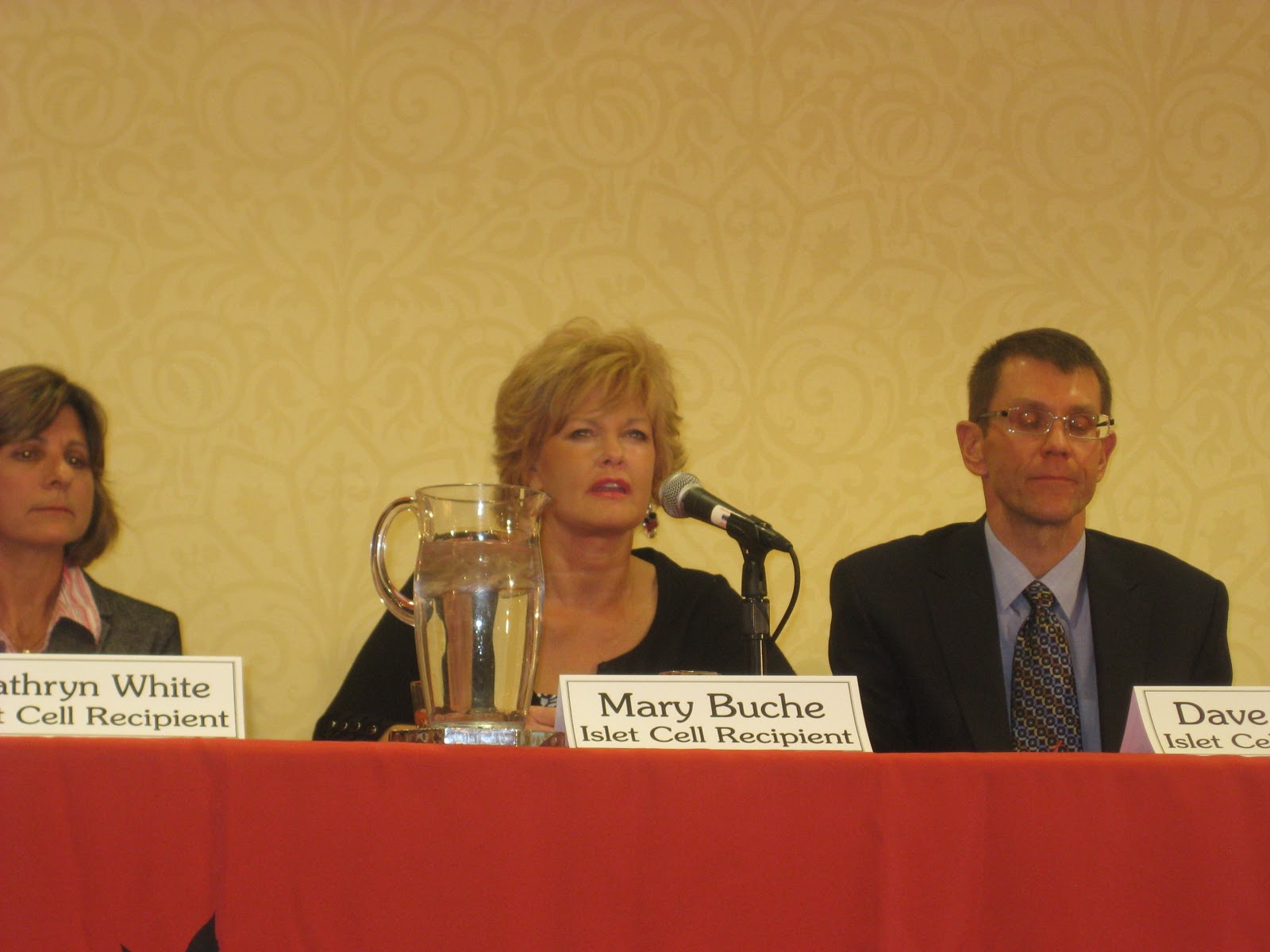
We made our way in to the larger meeting room where the actual Summit was to occur. The room was arranged with a podium beside a long table facing the audience. There were about 300 people in the audience. We were told that there would be people with various connections to diabetes. There were physicians and researchers, diabetes educators, and patients and their families.

Dr. Bortz gave an introductory speech that was very compelling. His perspective was how important this was to our health and well being and how fortunate we were to have had this option available to us.
Dr. Hering spoke first. He explained how islet cell transplants enable diabetics to live a healthy life both in the present and offered a much brighter future. He had slides that showed some recent results of how complications can actualy be reversed following islet cell transplantation. Another slide compared the difference in managing diabetes by tight control using current methods such as the pump and continuous monitor with that of transplant patients. The difference, not surprisingly was huge. Another slide showed the CITR (Collaborative Islet Transplant Registry) which includes data from all of the transplant centers results to that of the U. Minnesota (SDI). I might be biased, but I wasn't surprised to see that the Minnesota results fared better.

I was the first recipient speaker. We had decided that we would speak from our seats instead of the podium. It was probably a good thing, because my nerves were getting to me. Mary had to reassure me instead of vice versa which is what we had planned.
I began by thanking the Diabetes Research and Wellness Foundation for putting this on. We all think that this is such an important message to relate. We are in a very unique position to be able to offer hope to people who are in need of some. I commented on something that Dr. Bortz had said in his introduction comparing us to the miners in Chile who survived their ordeal thanks to a lifeline. I had described my transplant several times as the feeling that I had made a miraculous escape from a place that I didn't want to be. Then I told of how I had first seen the pig picture that led me to the Spring Point Project and then to the U. Minnesota site. I attempted to describe the freedoms that were allowed after I no longer needed to be on insulin. I compared my former path of controlling my diabetes with the mechanics offered by the pump and continuous monitor to the biological treatment of a transplant. It is like the comparison of Pinocchio and a real boy. I feel that this is a real and complete adjustment of my body's physiology. I tried to explain how it feels to have so much more energy. Some of these things you really have to experience to understand. I related that I now need to use a small dose of insulin. I admitted that this was frustrating, but that I understand that there are no guarantees at this point. Its just part of being treated in a clinical trial. The important thing is that I can still control my blood sugars. I ended by saying that if these islet cell don't last forever that I will go back to where I began and see if I can get pig islets cells after all.

Next was Mary Buche. She is the one of us who has remained insulin independent. She spoke of the many ways that her life has changed since her transplant in 2007. The part that struck me the most deeply was when she said that her coworkers who knew her well could tell when her blood sugar was low even when she could not. They would tell her to go sit down and test her blood sugar. When she did, it would be very low. She also had one incident when her son had to call 911 for her when she was experiencing a severe low. Since then, she became even more afraid of having lows to the point of keeping her BGs in the 150 range.
Dave Thoen was the third one of us to speak. He has received two islet cell transplants. One in 2008 and the second in 2009. He spoke of how difficult it was before the transplant because of his hypoglycemia unawareness. He would be fine one moment and low the next. Unfortunately, when he was very low, he would experience seizures. During one of his lows, his 3 year old son was able to help him through it. He said that was a low point for him in dealing with his diabetes and that he remembers thinking that his son might one day have to care for him, but not at age 3!

Ellen Berty was next. She was the only local recipient having had hers performed at the NIH Hospitals in 2001. Her stories were of driving incidents. She would feel a low coming on and stop her car wherever she might be. Sometimes in the middle of the road. The local police and paramedics who came to revive her came to know her well. She has written a book about her transplant experience. Its called
I Used to Have Type I Diabetes: Kiss My Islets. If the book is as animated as she is, it will be very interesting. I intend to find out.

Gary Kleiman had his transplant at the DRI. He also has had two kidney transplants, one from his mother and one from his brother. He said his family is afraid to have reunions anymore. He had his transplant at the time of his second kidney transplant in 2002. His background with the DRI makes him very knowledgeable about the transplant process and a very credible speaker. He also seems genuinely pleased with his results. He is a strong diabetes research advocate.

Karla was the last speaker. She also had her transplant at the DRI in 2005. Her story began early in her life. She was diagnosed at age 6. She had one incident with a low that sent her to the emergency room where they found her blood sugar at 10. She was very lucky to have survived that. Hearing this also made me feel for her parents. It must have been a constant fear for them for so many years. She does not take any insulin at this point, but does take one unit of Byetta before breakfast and dinner.
Our stories were varied in some ways. Different ages of onset, different drugs, different diets, and so on. We all have different lives but have this one gigantic part that we share. The common threads that I noticed were: physically- we had all lost weight and not gained it all back. We all seemed to feel very lucky to have had this opportunity and very compelled to tell others about it. We all had the highest regard for our doctors. None of us seemed to have any serious problems with the immunosuppressants. Our ages were similar. We don't take any of this for granted.
A question and answer period followed our talks. Members of the audience formed a line at a microphone and asked about what interested them. Many of the questions were medical and Dr. Hering fielded those. Looking at the audience, I noticed that when Dr. Hering spoke, everyone leaned in to catch every word. He answered questions about when this might be available to everyone, about encapsulation of islets, the success rates of the transplants and many others.
The questions covered many aspects of our experiences. People wanted to know about the drugs that we took and their side effects, about our weight, how we decided to do this, how we felt now, and more. We answered questions that we had experience with or opinion on. Sometimes several of us would give our thoughts on a question. Several questions were on behalf of a family member. Many people had never heard of islet cell transplants before the announcement of this summit.

Then it was over. We were able to speak directly to some of the members of the audience who approached us. I was able to exchange contact information with a few of the panelists. I hope to establish contact with each of them. It was an incredible experience that I will never forget. I felt extremely honored to be there for many reasons and had a wonderful time. I wish I could go back and relive it again and am hoping that I can in part by watching the video that was recorded during the various parts of the day. I'll post what I can here.
I'm so grateful to the
Diabetes Research and Wellness Foundation for putting this summit together. I hope that the goal of spreading this message is reached to the fullest. I believe that doing this is an important step in reaching the cure which is what we all want. This message might serve to encourage more people to try this option and if not, to at least have hope that the cure is within reach. I also hope that this will encourage funding and advocacy because these things are all needed to fuel the fire that is being created by these incredible researchers.
 As I mentioned in my previous post, the islet cell transplant study that has been ongoing for several years has been completed. The centers who make up the Clinical Islet Transplant Consortium have transplanted the needed 48 patients and now the study is closed. That is certainly the good news. It is a great coup for all the scientists and staff who have worked so hard to get this accomplished. The data will be collected and submitted to the FDA for approval. WHEN this occurs, islet cell transplants will become standard treatment for diabetics who can benefit from this type of intervention. Of course, insurance coverage will be another battle, but thats a separate topic. The estimated date is 2013, which is just amazing. I'm going to look into the possibility of pelting the FDA with success stories from the islet cell transplant patients that I have met. I don't think I would have to twist any arms to get them. We're a very happy group.
 So, how could there be any bad side to this? Its the human element. The patients who have invested their time, money, and most importantly their hopes in the process of qualifying for an islet cell transplant, only to get a call saying that the program is over/closed. There are several on the Pancreatic Islet Cell Recipients facebook page. My heart really goes out to them. I would have been devastated to have received one of those calls after I had been waiting for THE call. I know this is an unavoidable situation in the process, but I need to recognize it. Its really hit me hard.